Sea of Thieves' PlayStation Dominance Signals a New Multiplatform Era for Gaming
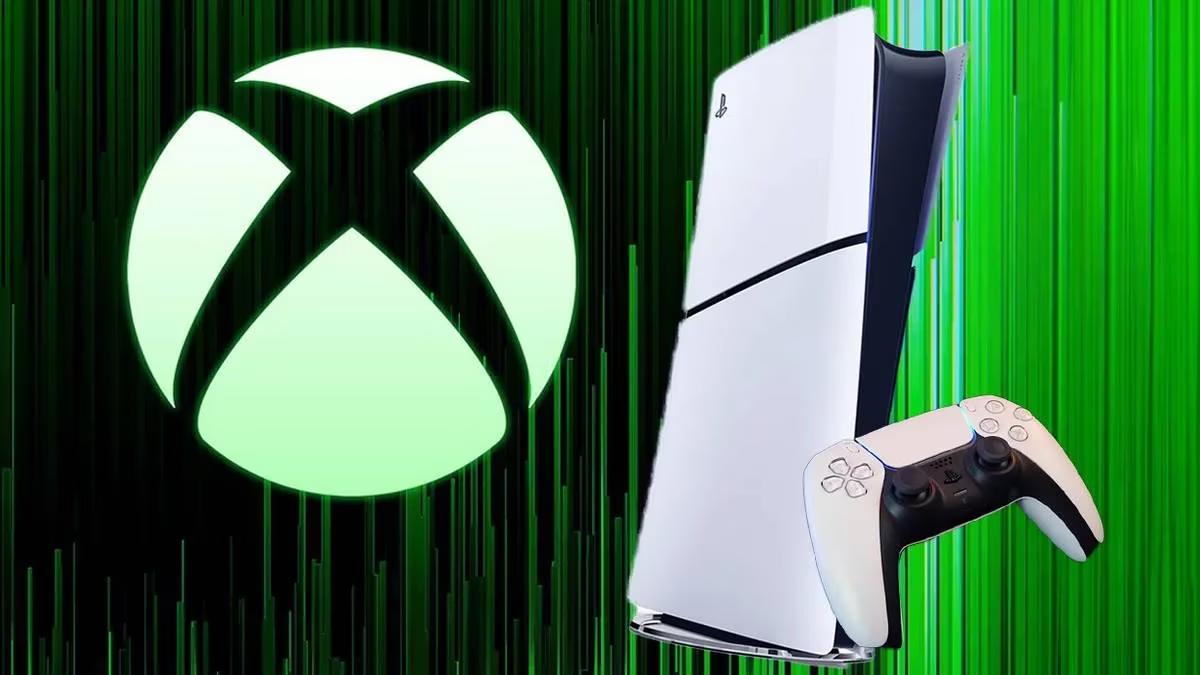
So, I was just browsing the latest gaming news, and something fascinating caught my eye. Remember when console exclusivity felt like an unbreakable rule? Well, the tides are definitely turning. As of now, in 2026, looking back at the pivotal shifts that started a couple of years ago, it's clear we're in a whole new era. The most compelling proof point? Sea of Thieves, once the crown jewel of Xbox and PC exclusivity, didn't just land on PlayStation 5—it absolutely stormed the castle. Upon its announcement for PS5 in early 2024, it skyrocketed to become the number one most pre-ordered game on the PlayStation Store in the United States. And get this, it wasn't just the standard edition; the Premium Edition claimed the top spot. Seeing a former Xbox exclusive leading PlayStation pre-orders felt like watching a paradigm shift in real-time. It wasn't a fluke; it was a harbinger.
This wasn't an isolated incident. It was part of a deliberate, strategic pivot announced by Microsoft during their February 2024 Xbox Podcast. Phil Spencer, the head of Xbox, laid out the reasoning with striking clarity. He stated that "games that are exclusive to one piece of hardware are going to be a smaller part of the game industry." Think about that for a second. He was essentially predicting the erosion of the high walls we'd grown accustomed to. He pointed out the existing blurring of lines, like console exclusives also launching on PC—a practice PlayStation itself had embraced with titles like God of War and Marvel's Spider-Man. Microsoft's move with Sea of Thieves, Hi-Fi Rush, Grounded, and Pentiment was just the next logical, yet bold, step in that direction. The success of Sea of Thieves on PlayStation served as the first major validation of this multi-platform philosophy.
The Ripple Effect: What Sea of Thieves' Success Truly Meant
The implications of this pre-order triumph were massive. For Microsoft, it was a resounding green light. A huge portion of their revenue was already coming from the subscription-based Xbox Game Pass ecosystem, accessible on PC, mobile, and cloud. Releasing a live-service game like Sea of Thieves on PlayStation wasn't cannibalizing their console sales; it was tapping into a vast, new player base and creating a new revenue stream. It proved that a game's community and longevity could be vastly expanded beyond its original hardware silo. This success paved the way for us, the players, to dream bigger. It immediately fueled intense speculation: which major Xbox exclusives could be next? Names like Starfield and Indiana Jones and The Great Circle were hot topics, showing just how much consumer expectations had changed almost overnight.
The New Gaming Landscape: Beyond Consoles
Fast forward to today, in 2026, and we can see the full picture. That initial move with Sea of Thieves wasn't a one-off experiment; it was the foundation of a new industry standard. The focus has decisively shifted from hardware lock-in to ecosystem and player reach. Here's what that looks like in practice:
-
Subscription & Access Over Ownership: Services like Game Pass and PlayStation Plus Premium have become the primary way many of us experience games. The question is less "what console do I need?" and more "what service has the games I want to play?"
-
Cloud Gaming's Ascent: The ability to play high-end titles on phones, tablets, and smart TVs has become seamless. The "console killer" Microsoft might have been planning evolved into making their game library available everywhere, making the physical box less critical.
-
Cross-Platform as Default: Multiplayer games now almost universally feature cross-play. The community is united, not divided. A game's success is measured by its total player count, not its console-specific metrics.
A Win for Us, the Players
Let's be real, as a player, this is fantastic news. We are the ultimate beneficiaries of this multiplatform world.
The Benefits Are Clear:
| Player Benefit | Description |
|---|---|
| Freedom of Choice 🎮 | I can choose the hardware I prefer (or can afford) without missing out on major game releases. |
| Preserved Communities 👥 | My friends and I can play together regardless of whether they're on Xbox, PlayStation, or PC. Games stay alive longer. |
| Value in Subscriptions 💰 | Services offer incredible value, letting me try a wide array of games for a monthly fee, including former "exclusives." |
| Developer Success 🚀 | Games have a larger potential audience, which can justify bigger budgets for ambitious projects and support for live-service titles for years. |
Of course, some nostalgia remains for the era of fierce console exclusivity. There was a special magic to a "system seller." But that model often felt restrictive. Now, the competition has shifted. It's about who offers the best service, the most compelling cloud experience, and the most player-friendly ecosystem. The success of Sea of Thieves on PlayStation wasn't just a sales statistic; it was a signal flare. It told the industry that players were ready for—and would enthusiastically support—a more open, connected, and platform-agnostic future. And here we are, living in it. The walls haven't just come down; we've built bridges in their place, and the view for gamers has never been better.